Analyze how political factors impact climate change in Bangladesh....
Analyze how political factors impact climate change in Bangladesh.
The political factors of climate change in Bangladesh are deeply intertwined with governance, policy, international diplomacy, institutional capacity, and local political dynamics. Here’s a structured analysis of these political factors.
1. Governance and Political Will
• Policy Commitment: Bangladesh has shown strong political commitment to climate action, evident in documents like the Bangladesh Climate Change Strategy and Action Plan (BCCSAP).
• Leadership in Advocacy: The government has taken an active role in global climate negotiations, positioning Bangladesh as a voice for vulnerable nations.
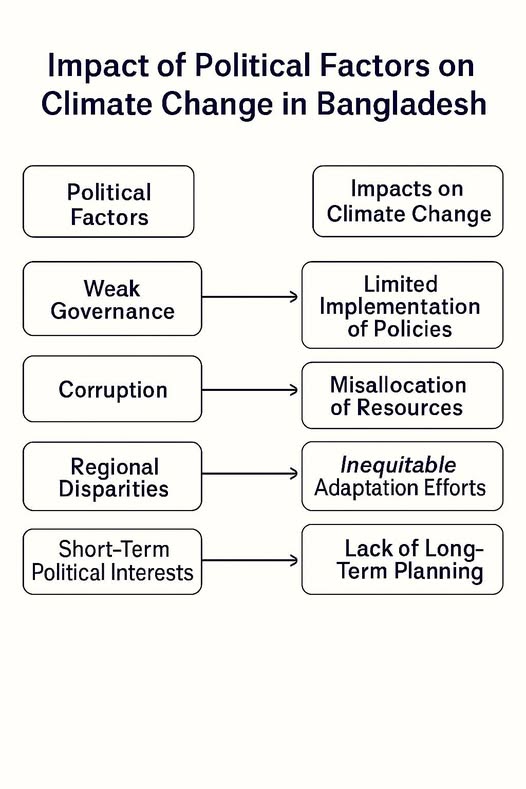
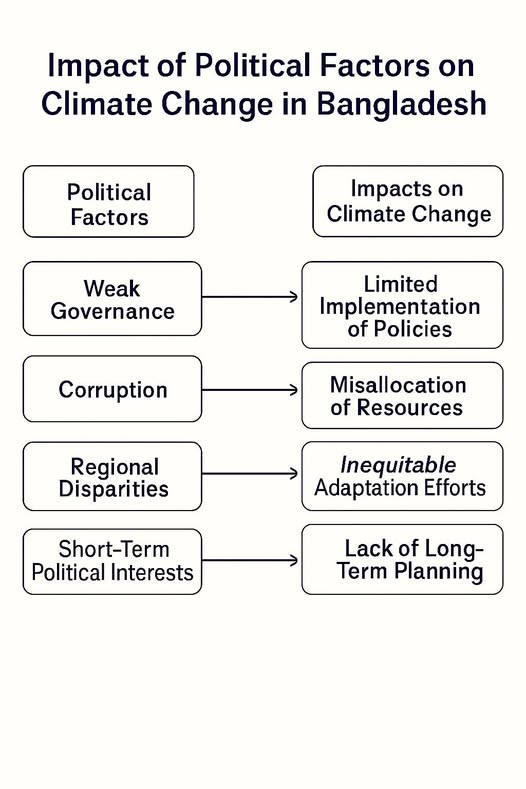
• Implementation Gap: While policies exist, there is often a disconnect between high-level political commitment and implementation at the local level, largely due to bureaucratic inefficiency and lack of coordination.
2. Institutional Framework and Capacity
• Dedicated Ministries: The Ministry of Environment, Forest and Climate Change (MoEFCC) leads climate policy, but coordination with other sectors (like agriculture, water, and urban development) is often weak.
• Decentralization Challenges: Climate governance is still centralized. Local governments lack the authority, technical skills, and funding to implement adaptation strategies effectively.
3. Corruption and Political Patronage
• Climate Finance Mismanagement: International and national climate funds are sometimes subject to misuse or political favoritism, undermining effectiveness.
• Project Allocation Bias: Projects may be allocated based on political allegiance rather than climate vulnerability or need, leading to regional disparities in resilience-building.
4. International Politics and Climate Diplomacy
• Climate Justice Advocacy: Bangladesh, as a climate-vulnerable country, actively advocates for Loss and Damage compensation and climate justice at COP meetings.
• Donor Dependence: Much of Bangladesh’s climate funding comes from international donors and institutions (e.g., Green Climate Fund, World Bank), which shapes national priorities to align with donor agendas.
• Geopolitical Pressures: Bangladesh must balance relations with large emitters like China and India while pushing for stronger climate action.
5. Electoral Politics and Populism
• Short-Termism: Politicians often prioritize short-term infrastructure or economic projects over long-term climate resilience to gain electoral advantage.
• Neglect of Climate in Elections: Climate change is rarely a central issue in electoral campaigns, despite its profound impact on livelihoods and migration.
6. Climate-Induced Displacement and Political Stability
• Migration Pressures: Displacement due to sea-level rise, river erosion, and floods is increasing, potentially destabilizing urban areas and creating governance challenges.
• Security Implications: Unmanaged displacement and resource scarcity (e.g., water conflicts) can exacerbate social tensions and political unrest.
7. Civil Society and Political Accountability
• Role of NGOs: Bangladesh’s vibrant civil society plays a crucial role in climate adaptation and awareness but often faces political resistance or co-optation.
• Limited Accountability: Political elites are rarely held accountable for climate inaction or mismanagement, due in part to weak democratic institutions and low civic engagement on environmental issues.
Conclusion
The political landscape in Bangladesh significantly shapes how climate change is addressed. While the country has made commendable progress in policy formulation and global advocacy, challenges such as corruption, weak local governance, and donor-driven agendas hinder effective implementation. For meaningful progress, Bangladesh needs stronger political accountability, inclusive governance, and a shift toward integrating climate resilience in electoral and development priorities.