Challenges Bangladesh Faces in Achieving the SDGs...
Challenges Bangladesh Faces in Achieving the SDGs
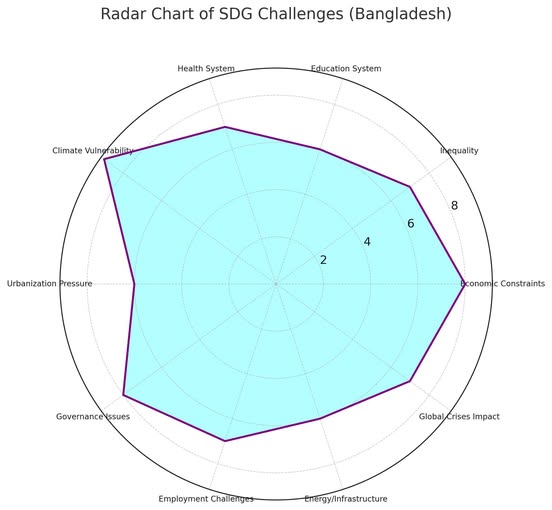
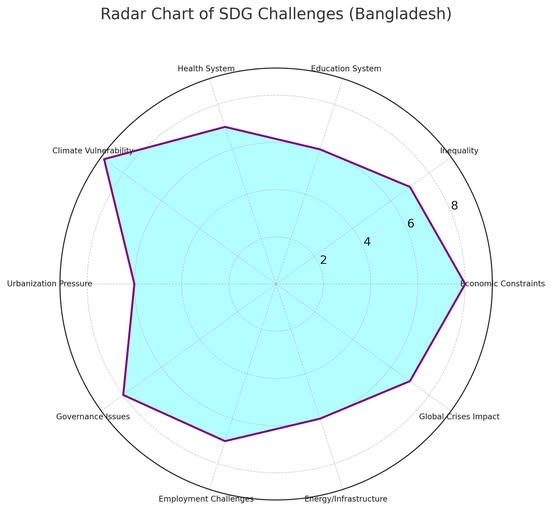
Bangladesh has made commendable progress on poverty reduction, health, education, and disaster management. However, several structural, economic, environmental, and governance-related challenges still make SDG attainment difficult.
1. Economic and Financial Constraints
a. Limited fiscal space
• Bangladesh’s tax-to-GDP ratio is among the lowest in South Asia.
• Low revenue means limited government funds for health, education, social protection, climate adaptation, and infrastructure.
b. Dependence on external financing
• Many SDG-related projects rely on foreign loans or aid, raising concerns about debt sustainability.
2. Persistent Poverty and Rising Inequality
• While extreme poverty has declined, income inequality and wealth concentration continue to grow.
• Urban–rural disparities in education, healthcare, and income prevent uniform progress.
• Vulnerable groups—informal workers, women, persons with disabilities—remain at risk.
3. Challenges in Education and Skill Development
• Dropout rates at secondary level remain high.
• Quality of education and teacher-student ratio need improvement.
• Skills mismatch limits employment opportunities for youth, affecting SDG 4 and SDG 8.
4. Health System Weaknesses
• Inadequate healthcare infrastructure, especially outside major cities.
• Shortage of doctors, nurses, and specialists.
• Rising rates of non-communicable diseases.
• High out-of-pocket health expenditure creates financial vulnerability for households.
5. Climate Change and Environmental Degradation
This is one of Bangladesh’s biggest obstacles.
a. High vulnerability to disasters
• Cyclones, floods, river erosion, salinity intrusion, and heatwaves threaten food security, housing, and livelihoods.
b. Environmental pollution
• Severe air pollution, especially in Dhaka.
• Water pollution from industrial waste and untreated sewage.
• Heavy dependence on fossil fuels.
These challenges affect SDGs on clean water, health, sustainable cities, climate action, and life below water/land.
6. Rapid Urbanization and Pressure on Cities
• Growing slums and informal settlements.
• Inadequate waste management, drainage, transport, and housing in major cities.
• Traffic congestion strongly affects economic productivity.
7. Governance and Institutional Limitations
• Weak coordination among ministries and agencies working on SDGs.
• Issues of corruption, bureaucratic complexity, and slow public service delivery.
• Limited use of data for monitoring SDG progress.
8. Employment and Economic Transformation Challenges
• Job creation is not keeping pace with population growth.
• Heavy reliance on ready-made garments (RMG) limits diversification.
• Automation and global economic fluctuations threaten future jobs.
9. Energy and Infrastructure Challenges
• High dependence on imported fuel increases costs.
• Renewable energy share is still low.
• Power shortages and grid instability affect industry and development.
10. Impact of Global Crises
• Post-COVID economic pressures.
• Russia–Ukraine war causing inflation, fuel price hikes, and currency depreciation.
• Global supply chain disruptions hurt exports and remittances.
Conclusion
Bangladesh’s path to achieving the SDGs is challenging due to financial constraints, climate vulnerability, governance limitations, and social inequality. Significant reforms in revenue generation, education, healthcare, environmental protection, and institutional coordination are essential to meet the 2030 targets.
#morphbangladesh
#DaffodilInternationalUniversity