What are the role of international organisations in the socio economic development
What are the role of international organisations in the socio economic development of Bangladesh?
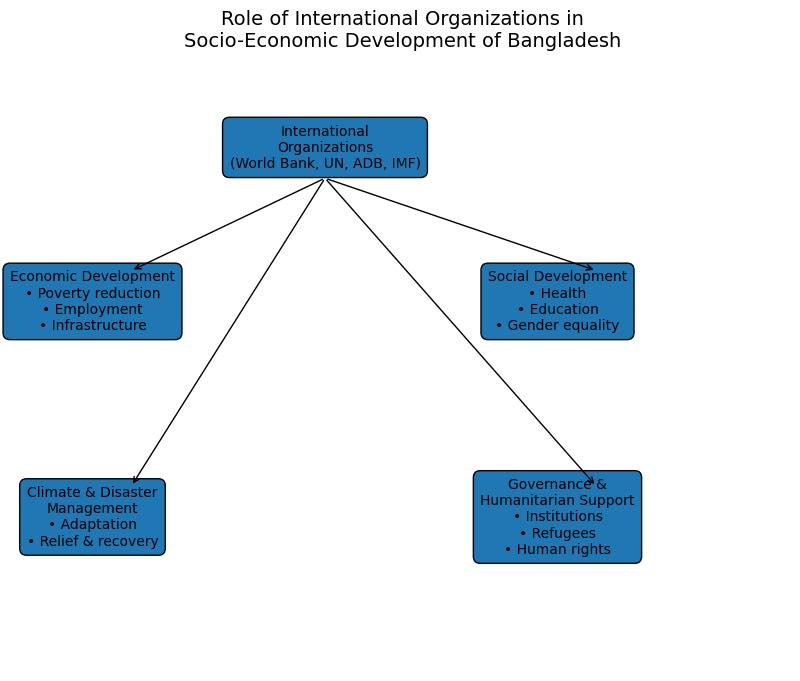
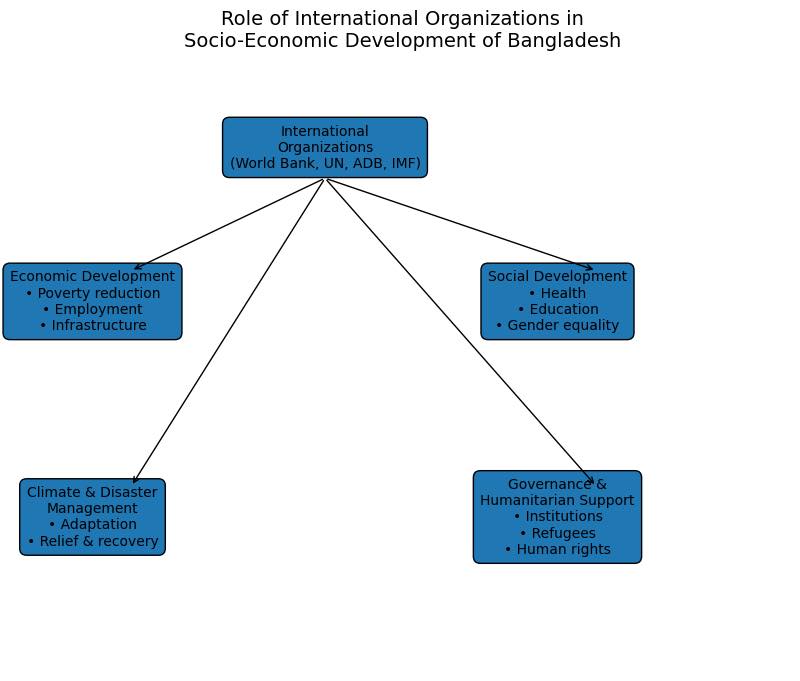
International organisations have played a significant and multifaceted role in the socio-economic development of Bangladesh since its independence in 1971. Their contributions span poverty reduction, health, education, infrastructure, governance, climate resilience, and humanitarian assistance. The key roles can be explained under the following headings:
1. Poverty Reduction and Economic Growth
• Organisations such as the World Bank, Asian Development Bank (ADB), IMF, and UNDP provide financial assistance, soft loans, and technical expertise.
• Support for macro-economic stability, budgetary reforms, and public financial management.
• Funding for rural development, microfinance, SME growth, and employment generation.
• IMF programmes help stabilize foreign exchange reserves and manage balance-of-payments challenges.
2. Health Sector Development
• WHO, UNICEF, UNFPA, and the World Bank support Bangladesh’s health system.
• Major contributions to:
• Expanded immunisation programmes
• Maternal and child health
• Family planning and reproductive health
• Support during health emergencies, such as COVID-19 response, vaccine rollout, and health system strengthening.
3. Education and Human Capital Development
• UNICEF, UNESCO, World Bank, ADB assist in:
• Universal primary education
• Girls’ education and gender parity
• Curriculum reform and teacher training
• Scholarships, stipends, and school feeding programmes reduce dropout rates.
4. Infrastructure and Energy Development
• Large-scale infrastructure projects funded by:
• World Bank, ADB, JICA, Islamic Development Bank
• Development of:
• Roads, bridges, ports
• Power generation and renewable energy
• Urban development and water supply
• These projects enhance connectivity, productivity, and investment.
5. Social Protection and Poverty Safety Nets
• Support for social safety net programmes targeting:
• The ultra-poor
• Elderly, widows, and persons with disabilities
• UN agencies and development partners help improve targeting, transparency, and digital delivery of benefits.
6. Gender Equality and Women’s Empowerment
• UN Women, UNDP, World Bank promote:
• Women’s economic participation
• Legal and policy reforms on gender equality
• Prevention of gender-based violence
• Support women entrepreneurs and workers, especially in the RMG sector.
7. Climate Change Adaptation and Disaster Management
• Bangladesh is highly climate-vulnerable; international organisations play a crucial role:
• UNDP, World Bank, ADB, FAO, Green Climate Fund
• Support for:
• Coastal embankments and cyclone shelters
• Climate-resilient agriculture
• Early warning systems and disaster preparedness
• Bangladesh is often cited as a global model for disaster risk reduction.
8. Agriculture and Food Security
• FAO, IFAD, World Food Programme (WFP) support:
• Improved crop productivity
• Climate-smart agriculture
• Food assistance during crises
• Nutritional programmes for vulnerable populations.
9. Governance, Democracy, and Institutional Capacity
• UNDP, World Bank, EU assist in:
• Public administration reform
• Judicial capacity building
• Anti-corruption initiatives
• Local government strengthening
• Election support and voter education programmes.
10. Humanitarian Assistance and Refugee Response
• Bangladesh hosts over one million Rohingya refugees.
• UNHCR, IOM, UNICEF, WFP provide:
• Shelter, food, healthcare, education
• Protection services and camp management
• Reduces pressure on Bangladesh’s national resources.
11. Trade, Labour Rights, and Industrial Development
• ILO, World Bank, WTO-related agencies support:
• Labour standards and workplace safety (post-Rana Plaza reforms)
• Skills development and productivity
• Trade facilitation and export diversification
Critical Perspective (Limitations)
While international organisations contribute significantly, there are concerns:
• Aid dependency
• Policy conditionalities affecting sovereignty
• One-size-fits-all development models
• Unequal power relations in global governance
Conclusion
International organisations have been key partners in Bangladesh’s socio-economic transformation—helping reduce poverty, improve human development indicators, build infrastructure, and enhance climate resilience. However, national ownership, good governance, and policy alignment remain essential to ensure that international support leads to sustainable and inclusive development.