The relationship between economy and politics is deeply intertwined and has been...
The relationship between economy and politics is deeply intertwined and has been the focus of many theoretical traditions across disciplines such as political science, economics, sociology, and philosophy. Here’s a structured overview of their theoretical relationship:
1. Interdependence of Economy and Politics
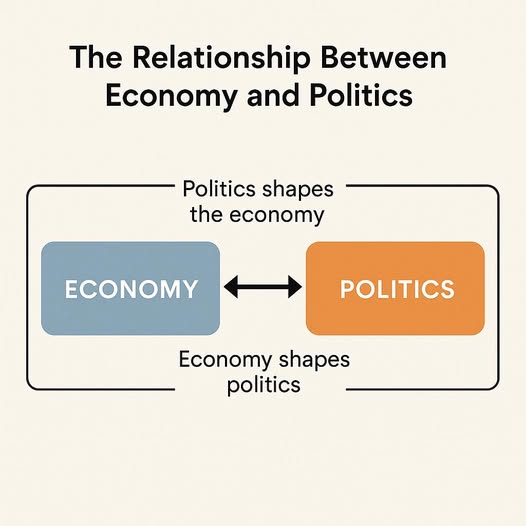
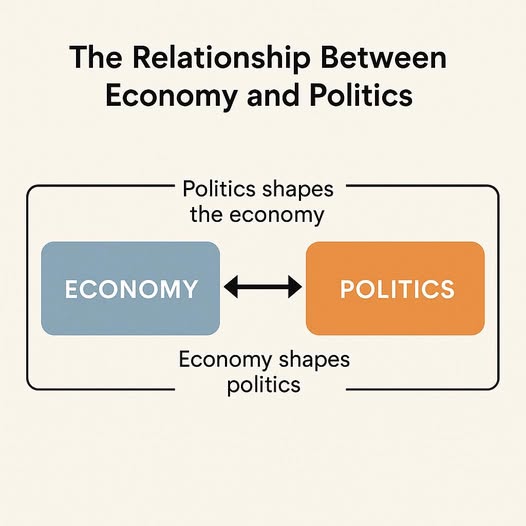
• Politics shapes the economy: Governments make policies on taxation, spending, regulation, and trade, which directly affect economic outcomes.
• Economy shapes politics: Economic conditions (like unemployment, inflation, or inequality) influence political stability, public opinion, and electoral outcomes.
2. Major Theoretical Perspectives
a. Classical Liberalism / Neoclassical Economics
• Key Thinkers: Adam Smith, John Locke
• Belief in a free market economy with minimal government interference.
• Politics should provide the framework (rule of law, property rights), but not interfere with market mechanisms.
• Separation between economics and politics is ideal.
b. Marxism / Political Economy
• Key Thinker: Karl Marx
• Politics is a reflection of the economic base (the mode of production).
• The state serves the interests of the ruling economic class (bourgeoisie in capitalism).
• Economic structure determines political superstructure.
c. Keynesianism
• Key Thinker: John Maynard Keynes
• Advocates active government intervention in the economy.
• Political decisions (e.g., fiscal and monetary policies) are necessary to manage economic cycles and ensure stability and employment.
d. Institutionalism
• Economic performance is shaped by political and legal institutions (rules, norms, governance structures).
• Institutions mediate the economy-politics relationship.
e. Public Choice Theory
• Applies economic reasoning to politics.
• Assumes politicians and bureaucrats act in self-interest, just like economic agents.
• Emphasizes inefficiencies in political decision-making (e.g., rent-seeking, lobbying).
3. Key Concepts in the Economy–Politics Nexus
* Political Economy: An interdisciplinary approach analyzing how economic theories and political processes interact.
* State and Market: The state regulates, supports, or restrains the market depending on ideology and interests.
* Power and Wealth: Economic power (wealth) can influence political power (e.g., campaign financing, lobbying), and vice versa.
* Globalization: It has shifted economic power to transnational actors, weakening the sovereignty of national politics.
4. Contemporary Debates
• Neoliberalism: Promotes deregulation, privatization, and market dominance, often criticized for weakening democratic control.
• Democratic Socialism: Advocates combining democracy with equitable distribution of economic resources.
• Authoritarian Capitalism: Some states (e.g., China) demonstrate how strong political control can coexist with capitalist economies.
Summary
Economy and politics are co-constitutive. Politics sets the rules of the game for the economy, while economic structures and interests shape political power and policy decisions.